Rammstein Biography
More actions
The beginning
The history of the band starts with Richard Kruspe, who accidentally walked into a riot in Berlin on 10 October 1989. He was arrested by the police and put into a truck, which drove him around for hours to Weißensee. There, he had to stand in front of a wall for six hours. If he moved, he was hit. After three days, he was released.[1] This experience made him want to leave the German Democratic Republic. He took the "green route" through Hungary and Austria to West Berlin.
After the Berlin Wall came down, Richard moved to Schwerin to join Till Lindemann. By that time, Till was working as a basket weaver. Every once in a while, he would sing while working. Richard stood there, listened, and liked his voice. He recorded Till's singing just for fun. By then, Richard was already living in a flat with Oliver Riedel and Christoph Schneider.[1][2] He came up with the idea of starting a new band. That was in 1993.[1]
After Olli left his previous band, The Inchtabokatables, Richard asked him to join his new project, and he agreed. After that, Richard also asked Schneider, who joined the band as well.[3] The three-piece started jamming and developing early versions of songs.[2] Remembering the recordings of Till's singing that he had made two or three weeks earlier, Richard also asked Till if he wanted to join the band.[1] Till came to Berlin but could not sing a single note until he had drunk a bottle of liqueur.[1] He then left with a tape full of music, to which he began writing and singing English lyrics.[4]
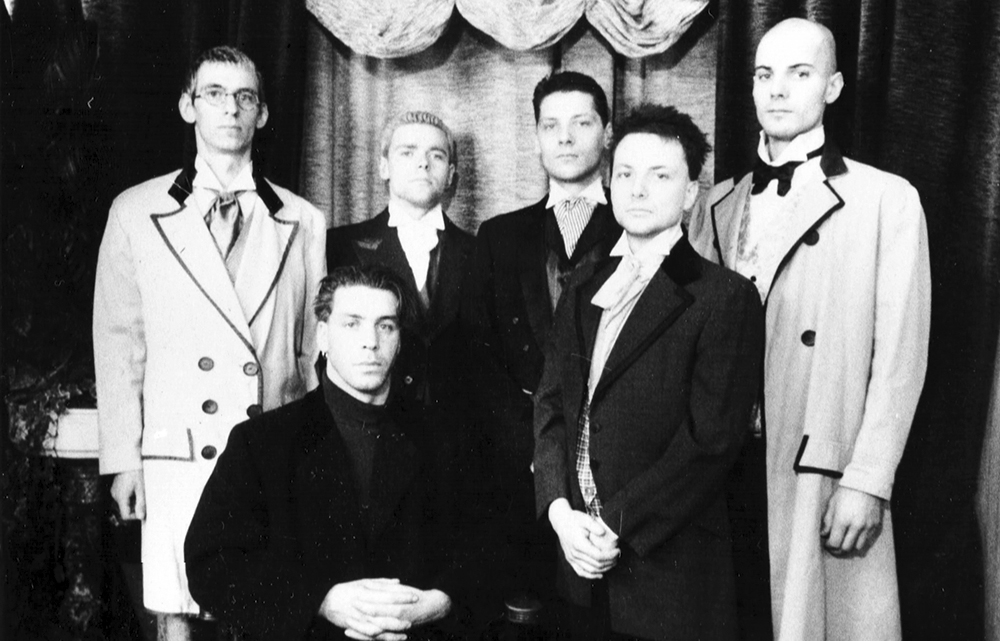
The band heard about the Metrobeat competition, for which a demo tape had to be submitted. They recorded four songs, one of them being an early English version of Weißes Fleisch, then called White Flesh,[5] and submitted the tape under the name Tempelprayers.[6] They performed four songs at the competition festival and immediately won the competition. The prize was one week in a professional recording studio.[1]

©Rammstein Archive
After hearing about the band's success, Paul Landers became aware of the band.[1] At first, Schneider did not want to play in a band with him. They had previously played together in bands such as Feeling B and Die Firma. Schneider even went so far as to say that he would leave the band if Paul joined. This was because Schneider had left Feeling B after a disastrous concert, promising himself that he never wanted to see any of them again.[7] However, he still liked Paul and decided to stay in the band.
The band also wanted Christian "Flake" Lorenz to join because they wanted his instrument in the lineup, and because he was different from other keyboardists.[3] After a while, the band wanted to take promotional photos, and Flake agreed to be in them.[7] The band later told Flake that they would really like him to join, but that if he decided not to become a member, there would be no way back.[7] Flake's only condition was that the band would sing in German rather than English.[8]
The band agreed, and with the previously won week of studio time, they recorded a few songs in German. During these studio sessions, the band discovered that reducing the 1 kHz frequencies in the mix emphasized the guitars and made them stand out significantly more. The studio's sound engineer later recommended this technique to other bands recording there.[9]
The band name
Up to that point, the band had been called Tempelprayers. The name Rammstein originated from an earlier idea of Schneider, Flake, and Paul.[1] They had wanted to form a band called Rammstein-Flugschau. They had already written that name inside their Robur LO during their time in Feeling B. By accident, they wrote Rammstein with two M's instead of one.[8] Before settling on Rammstein, the band also considered other names, including Milch (milk), Erde (earth), and Mutter (mother).[10]
First concerts
Their very first concert must have taken place in February 1994, while the band was still called Tempelprayers. The band is believed to have performed as a four- or five-piece (it is not known whether Paul was already a member at that point), in front of an audience of people from the music industry and journalists. It is also not known whether this performance was part of the prize for winning the competition or part of the competition itself. One member of the audience was Tatjana Besson, who had played in the band Die Firma together with Schneider.[10]
The first official Rammstein concert was held on 24 March 1994.[11] Their first show was as the unannounced support act for the band Acker Selection (sometimes also referred to as Golden Acker Rhythm Kings), which was Flake's brother's band.[12] The audience was shocked by the band, whose performance was a complete contrast to Acker Selection, which was more fun- and comedy-oriented.[12] After the show, Flake also performed with his brother's band.[12]
During the first concerts, Till wore two pairs of sunglasses, one over the other, to hide his anxiety and to make it harder for the audience to recognize him.[10]
Record label and manager

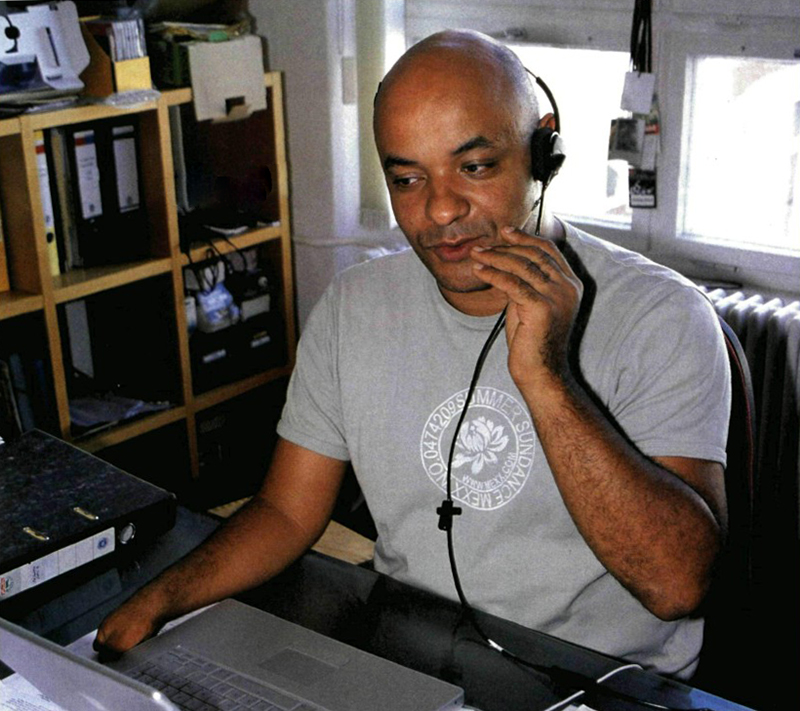
©Thorsten Zahn
One of the first record labels to approach the band and offer them the opportunity to record a demo tape was K&P-Musik. The band visited the label's offices and listened to their first demo together with its employees. However, the songs were not considered heavy enough, so the band was given a CD by Tass and left.[13]
Their future manager, Emu, already knew several members of the band from the German Democratic Republic. He knew Richard from Orgasm Death Gimmick and Paul and Flake from Feeling B. In 1993, the band approached him and asked him to become their manager. They played four songs for him (the known songs were Schwarzes Glas, Feuerräder, and Rammstein). At first, he declined, but he took the demo tape home and listened to it over and over again. He only agreed to manage the band after seeing them perform at the Knaack Club in Berlin. The band was still interested in working with him, and he became their manager.[14]
With Emu now as their manager, the band signed a contract with his company, Pilgrim Management. In 1994, Pilgrim sent demo tapes to many different record labels, but it was only after Motor Music showed interest in the band that other labels responded as well. The band chose Motor Music because its contract covered only three albums.[15]
Herzeleid
Now with a manager and a record label behind them, the band was ready to record their first album. The only problem was that they did not yet have a producer. To find one, they looked at who had produced their favourite bands. Their first choice was Greg Hunter, who had worked with Killing Joke. The band invited him to Berlin to watch them rehearse. After the first few songs, he did not say anything. After a few more, the band noticed that he had fallen asleep on the couch. After listening to the album Deaf Dumb Blind by Clawfinger and liking its sound, they decided to ask Jacob Hellner to produce the album. He gladly agreed, but would only work in Sweden. The band recorded the album at Polar Studios in Sweden, which had been built by the members of ABBA. They spent about a week there recording the drum tracks before moving to Jacob's own studio.
The band spent about three months recording the album. After the recording was finished, the initial decision was to have Jacob mix it as well. After Richard, who was the only band member still present, listened to the mix, he called the other band members, their manager Emu, and representatives from their record label to discuss it because he thought it sounded poor. They decided to have Ronald Prent mix the album instead. Richard believes that Ronald saved the album.[16]

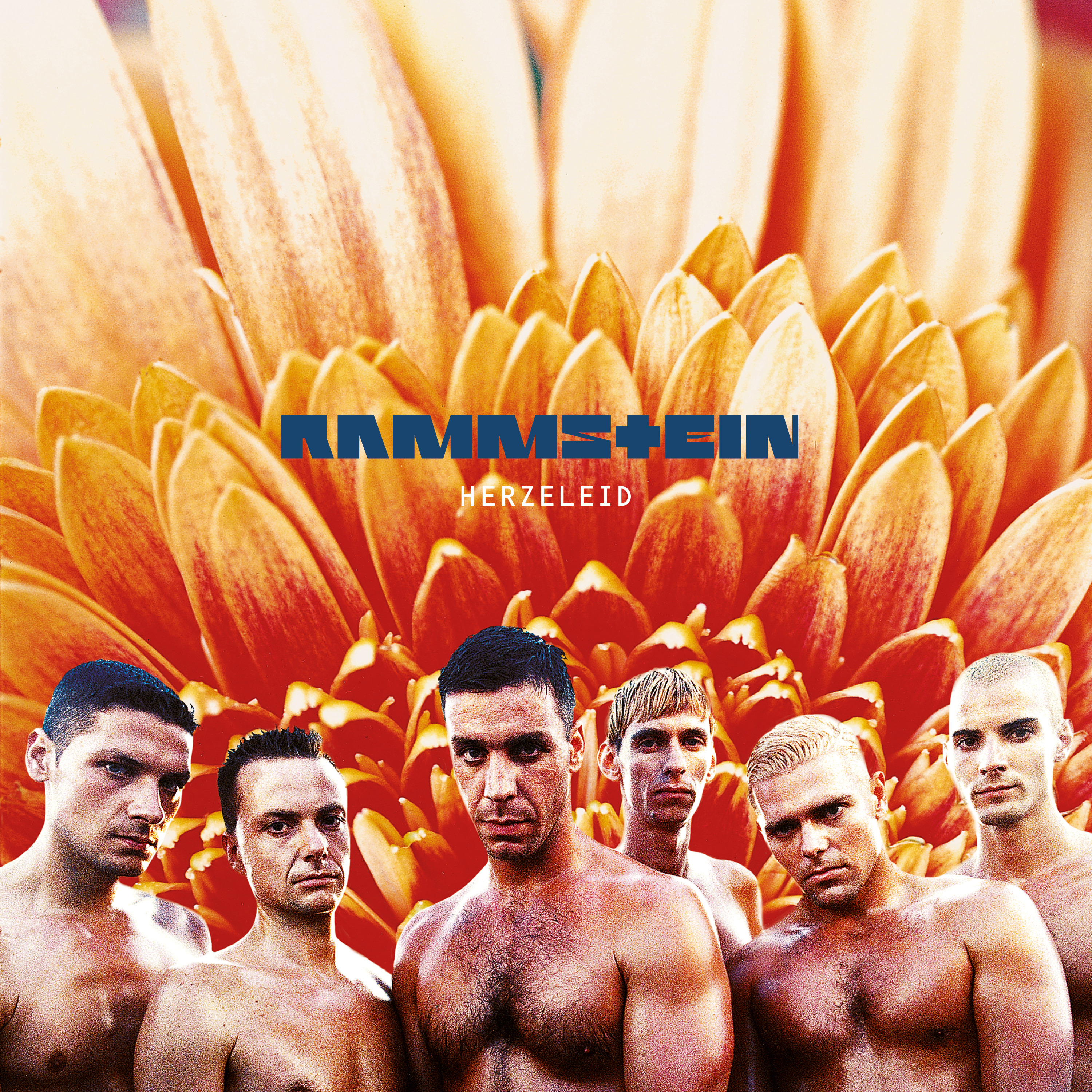
For the cover, the band chose a group photo with a flower in the background. Today, the band no longer likes the cover. In 2005, Till said: "Oh, the broiler photo (Broiler is Berlin slang for fried chicken). That's the worst cover we could imagine today."[17] The band also faced considerable criticism over the cover. In a 1997 interview with a German TV station, Flake said: "It was the best of a bad lot. Later you could read in the papers that we were portraying ourselves as members of the master race."[18]
The following Herzeleid tour began with a show on 8 August 1995. The tour took the band throughout Germany and to their first-ever concert in Switzerland. It ran from August to December 1995 but was interrupted by Rammstein supporting KMFDM on their αΩ tour for a total of 15 concerts in August and by two support shows for Clawfinger on their November tour, which marked the band's first performances in both Poland and Czechia. One notable concert took place on 8 September 1995, when the band played at a fashion show while models walked past them, showcasing different outfits. By that time, the band was already performing an early version of Sehnsucht. During another concert in December, the band also played the then-unknown song Sonne.[5]
The following year began with Rammstein once again supporting Clawfinger. The band joined them for three shows, the first two of which were their first performances in Austria. After that, Rammstein supported the Ramones on their farewell tour in Germany after playing two shows on their own headlining tour, which resumed once the Ramones dates had ended. During that period, the band made its first official television appearance. On 27 March 1996, Rammstein performed two songs on MTV Europe. During Du riechst so gut, Till struck himself on the head with the microphone to burst a small blood capsule, sending fake blood streaming down his face. The broadcast was then interrupted.
Another notable concert took place on 2 May 1996 in Hong Kong. The show was a showcase for Motor Music. Although Hong Kong is part of China today, it was under British rule from 1842 to 1997. Therefore, at the time of the concert, Rammstein performed in a British territory rather than in China.[19] The showcase was also the reason why Rammstein cancelled a month of planned shows in Germany in May.
During this tour, the band also began performing new songs such as Spiel mit mir, Tier, Bück dich, and Bestrafe mich. Rammstein's first official live video was also recorded in 1996. The concert took place on 27 September 1996 and was titled 100 Jahre Rammstein (100 Years of Rammstein). The title most likely referred to it being the 100th concert of the current tour, excluding label showcases and television appearances. The video was released to members of the official fan club at Christmas 1996.
From June to October, the band performed at several festivals in Germany and the Netherlands. One notable concert took place on 19 July 1996 at a Harley-Davidson Motorcycle Jamboree. Two and a half songs from the band's performance were later released on a VHS video.
Sehnsucht
In November 1996, the band began recording their second album, Sehnsucht. The album was recorded at Temple Studios in Malta and was once again produced by Jacob Hellner and Ronald Prent. Many of the songs that had been performed on the previous tour were reworked and finalized. These included Bestrafe mich, Bück dich, Tier, and Spiel mit mir from 1996, Sehnsucht from 1995, and Alter Mann, which is known to have been performed several times as early as 1994.
1997 marked the start of the Sehnsucht tour, during which the band performed some of the album's songs live for the first time. Du hast debuted on 9 April 1997, while Engel made its live debut one month later, on 6 May. Technically, Engel had already been performed in April, but only during a television appearance on the German TV channel RTL2, where it was performed entirely in playback. Another television appearance followed on 8 May 1997, during which playback performances of Engel and Rammstein were shown.
In August, Sehnsucht was released in a variety of formats: on CD and MC, as well as in a limited edition that included the standard CD and a T-shirt. Another limited edition was released as a cross-shaped digipak. In other parts of the world, additional editions were released with different bonus tracks. English-language versions of Engel and Du hast were included in some countries, sometimes as hidden tracks and sometimes listed on the track listing. Stripped was included as a bonus track in Australia, where a limited edition with a second CD was also released. France received a digipak with three bonus tracks, and in 1998 another German edition followed, featuring Du riechst so gut '98 as a bonus track.
After that, the band played a number of festivals across Europe, as well as their first-ever concert in the United States. During that concert, a stunt went badly wrong. Flake did not realize that the fluorescent tubes he used to break over Till were thicker than the ones he had used in Germany, so he had to strike the tube against Till's back repeatedly before it finally broke, causing Till to bleed immediately. Afterward, Flake threw the broken tube across the stage, where it became lodged in Schneider's arm.[20] The concert was also attended by Wayne Pighini, who worked for London Records at the time and decided not to sign the band after seeing the performance.[20]
After the festival tour ended, the band began their headlining tour of Germany. The tour started on 26 September 1997 in Emden. During that concert, the roof of the venue caught fire.[21] It may also have been the only time that Eifersucht was ever performed live, although that information comes from an article in the German teen magazine BRAVO, which was also known for publishing inaccurate information. The following day, the band played in Hamburg, and a few excerpts from the performance were broadcast on a German television show.[22] A month later, on 23 October, the band performed in Düsseldorf. KMFDM supported Rammstein, and during their song Liebeslied, Richard and Till came on stage and threw something into the crowd.[23] Several songs were recorded during this concert, with Spiel mit mir later being released on the DVD Lichtspielhaus.
In mid-November, the band began their European tour, which took them to Sweden, Denmark, Spain, Italy, Poland, France, the United Kingdom, Belgium, and the Netherlands. Their show on 29 November 1997 was broadcast in full on the Dutch radio station Kink FM. In December, the band began a tour of the United States as support for KMFDM. The show on 14 December 1997 was attended by Michael Arfin, who subsequently agreed to become their U.S. booking agent.
Sehnsucht Tour
In 1998, the Sehnsucht tour brought the band to the United States once again. For their show on 4 May, the band was not allowed to use any pyrotechnics,[24] making it one of the few concerts they ever performed without pyro. The songs Heirate mich and Du hast from the 31 May show at Rock am Ring were later released on Lichtspielhaus. On 10 August, the band played their first-ever concert in Hungary. During the band's performance at the Zillo Festival, a couple got married on stage during Heirate mich. On 22 and 23 August, the band performed two shows at Berlin's Wuhlheide. Both concerts were recorded and released the following year as Live aus Berlin on VHS, DVD, as well as on CD.
In September 1998, the band joined the Family Values Tour, which was created and headlined by Korn. During the tour, Rammstein got into trouble with the local police. At their Halloween show, the band members performed almost naked and were dragged off stage one by one, causing the concert to end after only three songs.[20] On 12 November, Rammstein performed Du hast live at the MTV Europe Music Awards in Assago, Italy. This was the band's final performance of 1998.
1999 was supposed to begin with Rammstein performing at the Big Day Out festivals in New Zealand and Australia in January. After the festival appearances, the band was scheduled to perform in Japan and Germany. All of these dates were eventually cancelled because Schneider had perforated his eardrum and was not allowed to fly or be exposed to loud music or explosions for several months.[25]
Despite the injury, Rammstein resumed touring in early April. The band supported KISS on their "Psycho Circus" tour in Latin America while also playing one headlining show of their own on 21 April. Their first performance, on 10 April, took place in Buenos Aires, Argentina. It was the band's first concert in the country, and the entire performance was broadcast on an Argentine radio station. Parts of several songs were also shown on television. Their next show, on 15 April, marked the band's first performance in Brazil. At their following Brazilian show, on 17 April, the audience reacted very negatively. They booed the band, gave them the middle finger, and threw objects onto the stage.[20]
The headlining show on 21 April marked the band's first performance in Mexico. On an unknown date, the band held a press conference at a record store, followed by a signing session for fans. When they arrived, a large riot was already underway, with riot police trying to keep the crowd under control. The band managed to get inside the store, where the local police chief urged them to go onto the roof and address the fans in an attempt to calm them down. He warned that if they refused, they would be arrested. Till spoke broken Spanish through a megaphone from the roof of the store, and the crowd eventually calmed down.[20]
In June, the band returned to the United States for another headlining tour. Their entirely English-language song Stripped made its live debut during this period. The band also encountered the police on several occasions. On 5 June, both Till and Flake were arrested for "public indecency" after the show because of their performance of Bück dich. They spent five hours in jail before their bail was paid. The incident had long-term consequences for both of them, as they had to return to court in Worcester during the tour and again on subsequent visits to the United States.[20][26] On another occasion, Till was placed in a police van after urinating between two garbage bins behind the stage in Texas.[20] Finally, on 15 June, the band's performance was cut short after city officials dispatched police officers to the venue.[20]
Mutter
From September 1999, the band rented Haus Weimar in Heiligendamm. The house was completely unfurnished, so the band had to install a kitchen and toilets and buy beds and cupboards. Every song written there eventually ended up on the album. According to Flake, "90% waste" was recorded as well. The band stayed there until December 1999 before moving to Berlin, where they continued working on the songs. At the same time, the band was also looking for a recording studio. Olli explained the requirements: "It is supposed to be abroad. The drums should be able to be recorded there so we can play together and change things. And it should be beautiful."
On 16 April 2000, the band played a concert exclusively for members of their official fan club. Every song performed was an early version of material that would later appear on the following album or its associated releases.
In May 2000, the band went to Studio Miraval in Correns, France. They recorded all the songs there over the course of six weeks. During the recording sessions, Richard became such a control freak that the band nearly split up. Schneider stated: "We reached the limit when it became impossible to mention the name 'Richard' without adding an 'idiot' or 'asshole'! It's strange that there were no personal complaints. But as soon as it came to music, Richard was the last person we wanted to listen to. He needed a good lesson!"[27] For one song, although it is not known which one, Till wrote 24 different sets of lyrics before everyone in the band finally agreed on one.
In June 2000, the band went to Galaxy Studios in Mol, Belgium, to have the album mixed. They once again worked with Ronald Prent, who had also mixed Herzeleid and Sehnsucht. The record label invited journalists to the studio to listen to six songs, one of them being Sonne, which was still known by its working title Klitschko. However, the band felt that the mix sounded too conventional and not spectacular enough. They wanted Andy Wallace or Dave Ogilvie to mix the album instead, but neither was available at the time. Before commissioning a new mix, the band played their first concert in Japan on 30 July.
The band moved to Stockholm in October 2000, where Stefan Glaumann was available to mix the album. Flake said that he was very good, but also very slow. He needed five days to mix one song, followed by two days of rest. During that time, the band moved into the flat of an elderly couple who had recently died. Their son asked the band not to change anything because it helped him cope with the death of his parents. While in Stockholm, the band met Peter Tägtgren, which years later led to the formation of the band Lindemann. Flake nearly got into a fight with some people in a bar, and Peter helped calm the situation down. Eventually, the mix was finished, and the band was happy with the result.
During a second listening session, eight songs were premiered: Sandmann (the working title of Mein Herz brennt), Ohne dich, Mutter, Sonne, Nebel, Adios, Pastor (the working title of Halleluja), and Rein raus.
On 18 January 2001, the band performed in New Zealand for the first time. Finished versions of Links 2-3-4 and Sonne also debuted at this concert. On 21 January, the band performed in Australia for the first time.
Reise, Reise
To be added.
Rosenrot
To be added.
Liebe ist für alle da
To be added.
Made in Germany 1995-2011
To be added.
Untitled
To be added.
Sources
- ↑ 1.0 1.1 1.2 1.3 1.4 1.5 1.6 1.7 Rammstein book by Gert Hof
- ↑ 2.0 2.1 Mix mir einen Drink, page 372
- ↑ 3.0 3.1 Mix mir einen Drink, pages 374–375
- ↑ Mix mir einen Drink, page 373
- ↑ 5.0 5.1 Heute hat die Welt Geburtstag, page 193
- ↑ Motor Music
- ↑ 7.0 7.1 7.2 Mix mir einen Drink, page 374
- ↑ 8.0 8.1 Mix mir einen Drink, page 376
- ↑ RammWiki conversation with the sound engineer of the studio
- ↑ 10.0 10.1 10.2 Mix mir einen Drink, page 377
- ↑ mail conversation between Flake's brother and RammWiki staff
- ↑ 12.0 12.1 12.2 30 Jahre naTo, page 168
- ↑ Mix mir einen Drink, page 386
- ↑ Metal Hammer Germany, Rammstein special 2004, page 8
- ↑ Orkus Magazine Germany, 1997, page 136
- ↑ Loudersound.com - Rammstein: the story behind their debut album Herzeleid
- ↑ Metal Hammer Germany, 11/2005, page 37
- ↑ Rammstein - Who are they?, minute 27
- ↑ British Hong Kong, Wikipedia
- ↑ 20.0 20.1 20.2 20.3 20.4 20.5 20.6 20.7 Rammstein in Amerika documentary
- ↑ Die Zusammenkunft Forum
- ↑ Stars Aktuell 1997
- ↑ KMFDM performance of Liebeslied
- ↑ Chicago Tribune article
- ↑ Announcement from the official Big Day Out website
- ↑ Rammstein’s Act Lands Two Members In Jail
- ↑ Rock Hard Magazine 2004